
Pathways of Vulnerability
Neurodegeneration results from changes in a complex molecular milieu that emerge as a disease over the course of many years. These diseases progress over selectively vulnerable brain networks that, if protected, would improve patient outcomes. An understanding of the cascade of molecular events that ultimately lead to neurodegeneration in vulnerable neurons, especially in sporadic cases, has proven elusive. In fact, even when known pathogenic variants are established for a neuropathologic entity, the exact pathways to disease can remain opaque. A fundamental understanding of the pathways underlying both neuronal vulnerability and resilience to neurodegeneration will lead to improved therapies for familial and sporadic cases alike.
Selective vulnerability in FTLD-TDP
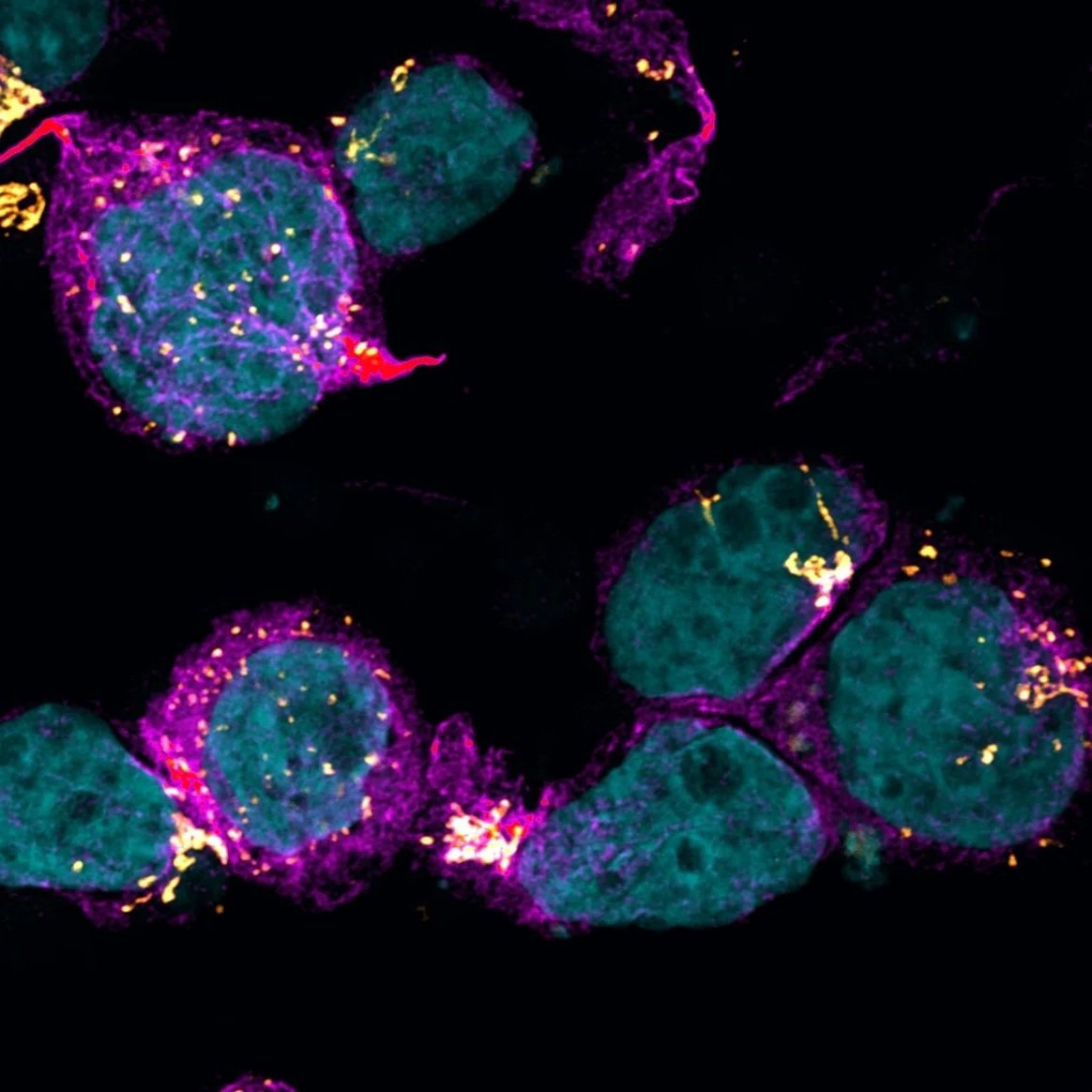
Although TDP-43 lesions are a central driver of neuronal loss across diseases such as FTLD and ALS, only specific neuronal populations degenerate, even in individuals carrying pathogenic germline variants. This highlights a fundamental gap in understanding selective vulnerability. We address this by integrating spatially resolved single-cell transcriptomics of postmortem human brain tissue with CRISPR-based functional genomic screening in engineered human cell models. By comparing resilient and vulnerable neurons across multiple genetic forms of TDP-43 disease, we systematically identify candidate modifiers of TDP-43 dysfunction, then functionally test these candidates using combinatoric functional genomic screening and high-content phenotypic assays. This combined human tissue-anchored and mechanistic approach is designed to uncover conserved, translationally actionable mechanisms of neuronal resilience that may inform therapeutic strategies across a broad range of neurodegenerative disorders.

NEURODEGENERATIVE PATHOGENESIS In The Locus coeruleus
The locus coeruleus is a deeply conserved brainstem nucleus responsible for the vast amount of norepinepherine production in the brain. Morphological constraints have limited isometric scaling between the locus coeruleus and total brain size, possibly subjecting it to a great deal of oxidative and metabolic stress in large-brained animals such as humans. Several neurodegenerative diseases, including Alzheimer’s, feature early neurodegeneration in the locus coeruleus. Work done with Prof. Lea Grinberg and our group has established that the locus coeruleus is among the earliest affected regions in Alzheimer’s disease, contributes to neuropsychiatric symptom formation in Alzheimer’s disease, and is vulnerable due to unique cholesterol homeostatic mechanisms. Further work in collaboration with international consortia has leveraged the pattern of degeneration in the locus coeruleus as a novel biomarker for Alzheimer’s disease.
Featured publications
Ehrenberg AJ, Sant C, Pereira FL, Li SH, Buxton J, Langlois S, Trinidad M, Oh I, Leite REP, Rodriguez RD, Paes VR, Pasqualucci CA, Seeley WW, Spina S, Suemoto CK, Temple S, Kaufer D, Grinberg LT. Pathways underlying selective neuronal vulnerability in Alzheimer's disease: Contrasting the vulnerable locus coeruleus to the resilient substantia nigra. Alzheimer's & Dementia: The Journal of the Alzheimer's Association. 2025. PMID: 40135662. PubMed
Ehrenberg AJ, Suemoto CK, Resende EDPF, Petersen C, Leite REP, Rodriguez RD, Ferretti-Rebustini REL, You M, Oh J, Nitrini R, Pasqualucci CA, Jacob-Filho W, Kramer J, Gatchel J, Grinberg LT. Neuropathologic correlates of psychiatric symptoms in Alzheimer’s disease. Journal of Alzheimer’s Disease. 66(1): 115-126. 2018. PMID: 30223398. PubMed
Eser RA, Ehrenberg AJ, Petersen C, Dunlop S, Mejia MB, Suemoto CK, Walsh CM, Rajana H, Oh J, Theofilas P, Seeley WW, Miller BL, Neylan TC, Heinsen H, Grinberg LT. Selective Vulnerability of Brainstem Nuclei in Distinct Tauopathies: A Postmortem Study. Journal of Neuropathology and Experimental Neurology. 77(2): 149-161. 2018. PMID: 29304218. PubMed
Ehrenberg AJ, Nguy AK, Theofilas P, Dunlop S, Suemoto CK, Alho AT, Leite RP, Rodriguez RD, Mejia MB, Rüb U, Farfel JM, Ferretti-Rebustini REL, Nascimento CF, Nitrini R, Pasquallucci CA, Jacob-Filho W, Miller B, Seeley WW, Heinsen H, Grinberg LT. Quantifying the accretion of hyperphosphorylated tau in the locus coeruleus and dorsal raphe nucleus: the pathological building blocks of early Alzheimer's Disease. Neuropathology and Applied Neurobiology. 43(5): 393-408. 2017. PMID: 28117917. PubMed
Theofilas P, Ehrenberg AJ, Dunlop S, Di Lorenzo Alho AT, Nguy A, Leite REP, Rodriguez RD, Mejia MB, Suemoto CK, Ferretti-Rebustini REL, Polichiso L, Nascimento CF, Seeley WW, Nitrini R, Pasqualucci CA, Filho WJ, Rueb U, Neuhaus J, Heinsen H, Grinberg LT. Locus coeruleus volume and cell population changes during Alzheimer's disease progression: A stereological study in human postmortem brains with potential implication for early-stage biomarker discovery. Alzheimer's & Dementia: The Journal of the Alzheimer's Association. 13(3): 236-246. 2017. PMID: 27513978. PubMed